



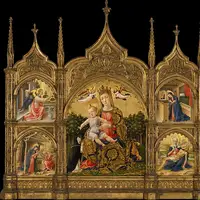










































Bartolomeo Vivarini’s painting, completed around 1465, is a remarkable example of spiritual symbolism. This artwork consists of three panels that display important events from Mary’s life. They are painted in tempera and gold on wood, giving them a bright and luxurious look. Vivarini was active from 1450 to 1499 in Venice, a major center of Renaissance art and culture. His work shows great skill in depicting religious scenes with deep meaning.
In the central panel of this masterpiece, Mary, the mother of Jesus, is sitting on the ground, which symbolizes the idea of humility despite her royal status. She holds baby Jesus, emphasizing the connection between divinity and humanity. Her clothes show her royal standing with colors such as red and blue, which signifies importance and purity. The gold makes her look both important and holy. Surrounding Mary, a group of angels creates a celestial atmosphere that enhances the spiritual nature of the scene.
The left panel of the artwork focuses on the Annunciation, which is one of the most important events in Christian history. Here, the angel Gabriel is seen announcing to Mary that she will have a son, Jesus. This moment marks the beginning of something divine and is portrayed with simplicity and grace in the painting.
Moving to the lower scenes, Vivarini illustrates the Nativity and Pietà. The Nativity captures the birth of Jesus, portrayed with warmth and love, while the Pietà depicts Mary holding Jesus after his crucifixion, showing deep sorrow and loss. These scenes highlight the profound love and sacrifice inherent in Mary’s life. The backdrop, rich with gold, connects these stories and emphasizes their holy significance. Vivarini’s use of color and composition effectively blends human emotion with divine presence, creating a spiritually uplifting work.