

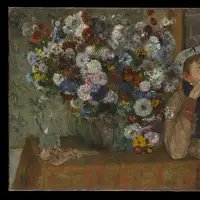








































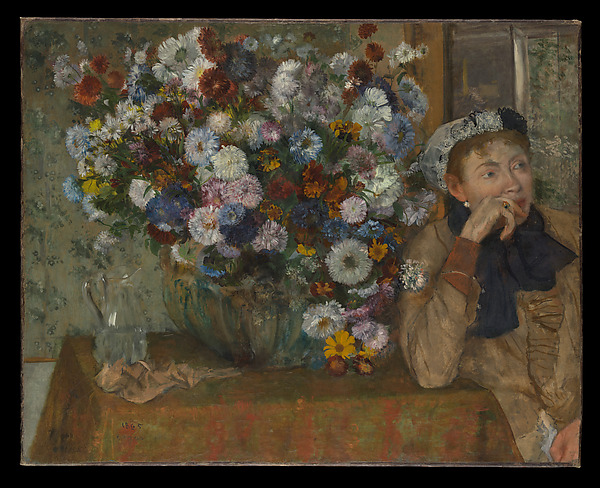
Edgar Degas's painting, 'A Woman Seated beside a Vase of Flowers,' captures a quiet moment in 1865 that speaks volumes about human emotion. The woman appears as if she is deeply lost in her thoughts, with her elegant hand resting thoughtfully on her chin. Her dress is simple yet stylish, which enhances her calm demeanor. Next to her, the large vase is filled with vibrant flowers, including beautiful blue, red, and yellow hues. The warm light from the side not only illuminates the flowers but also highlights the expression on the woman's face. This light creates a welcoming atmosphere, drawing viewers into the scene. Degas skillfully uses soft brushwork to enhance the sense of intimacy between the viewer and the subject. The flowers symbolize beauty and life, while the woman reflects a deeper emotional state. She may represent feelings of loneliness or contemplation, making the painting rich in psychological complexity. This piece demonstrates Degas's talent for portraying human isolation and introspection, themes that recur throughout his body of work. By focusing on these everyday subjects, he elevates simple moments into areas of deep significance. The painting is currently part of the collection at The Metropolitan Museum of Art in New York, where many visitors have experienced its beauty firsthand. Degas, who has created numerous masterpieces, often portrays dancers, but paintings like this one show that he had a profound understanding of more than just movement — he understood emotion itself. If we look closely, we can see that Degas transforms ordinary life into art that resonates with the viewer.
B1 · Intermediate · 259 words · ~2 min
Edgar Degas · 1865 · Oil on canvas · The Met
Exploring a Moment of Reflection
Word notebook · B1
Tap a highlighted word in the text, or study the list below.
- introspection
- the act of thinking about one’s own thoughts and feelings.
- elevates
- raises something to a higher position or status.
- psychological
- relating to the mental and emotional state of a person.
- complexity
- the state of having many different parts; difficulty in understanding.
- symbolizes
- represents something else, often having a deeper meaning.
- vibrant
- full of energy and life; bright and striking.
- contemplate
- to think deeply about something.
- mastery
- great skill or knowledge in a particular area.