



































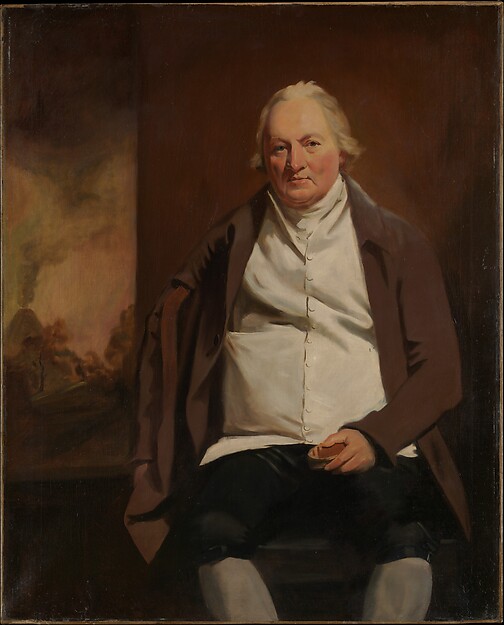
In the painting 'John Gray' by Sir Henry Raeburn, we see a clear representation of John Gray, who lived from 1731 to 1811. He has a large build and a serious expression, which suggests a strong personality. His clothing is simple, featuring a white shirt and a dark coat that reflect the modesty of that era. The background is a deep brown, which helps to focus on his face and makes the viewer concentrate on his expression. The light falls softly on him, emphasizing his character and creating a calm mood that invites reflection. Raeburn, who was born in Scotland in 1756, has used oil on canvas to capture Gray's likeness. This choice of medium allows for rich details and depth in the portrait. This painting is significant not only because it shows Raeburn's skill in connecting the subject with the viewer, but also because it gives insight into the important style of Scottish portrait painting during the 18th century. If you look closely, you can see how Raeburn aimed to present Gray's personality and strength, which were important traits at that time. In addition, this portrait remains an example of how artists have interpreted identity and societal roles through their work, influencing future generations of painters.
B1 · Intermediate · 207 words · ~1 min
Sir Henry Raeburn · · Oil on canvas · The Met
Interpreting John Gray's Portrait
Word notebook · B1
Tap a highlighted word in the text, or study the list below.
- modesty
- the quality of being humble or simple, not showing off
- canvas
- a strong cloth used by artists to paint on
- depth
- the quality of being deep; in art, it often refers to how three-dimensional an image looks
- reflect
- to think deeply or carefully about something
- invites
- to make someone want to come to a place or do something
Comprehension check · B1
Finished reading? See how much stuck.
1.What aspect of John Gray's character does his clothing reflect?
2.What medium did Sir Henry Raeburn use for the painting?
3.How does the painting portray the relationship between the subject and the viewer?